Home Espresso Machines: A Beginner’s Guide to Choosing the Right One
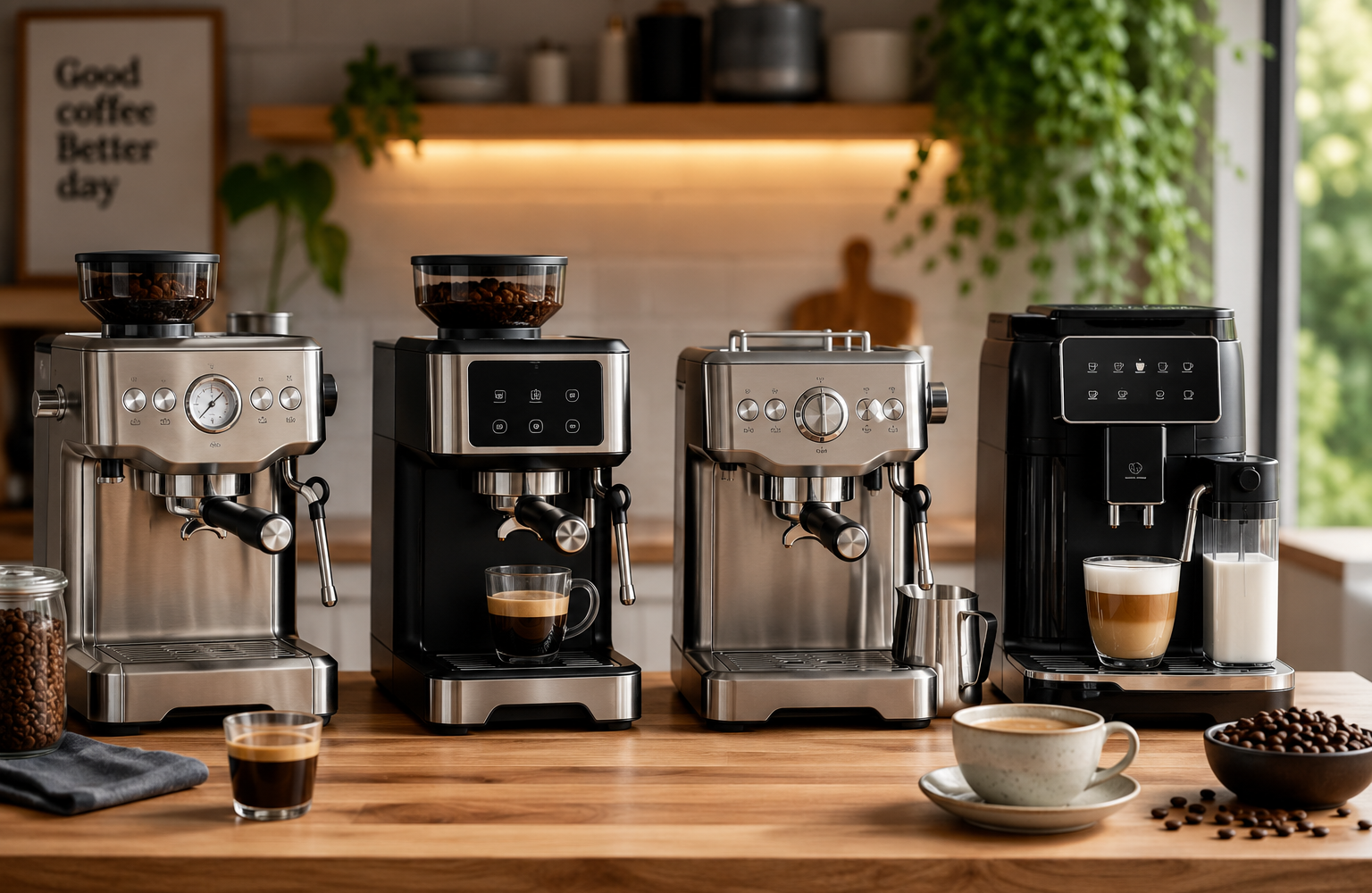
Buying an espresso machine for your kitchen sounds simple until you start shopping.
One machine costs a few hundred dollars. Another costs well over $1,000. Some require you to grind and prepare the coffee yourself, while others can make a cappuccino with the press of a button. Then there are specifications such as pump pressure, boilers, grinders, temperature control and milk systems.
The good news is that choosing between home espresso machines becomes much easier once you stop asking which machine has the most features and start asking a more useful question:
How involved do you want to be in making your coffee?
The right espresso machine should match your routine, the drinks you actually make, your available counter space and how much maintenance you are willing to do.
This guide explains the important differences so you can understand what you’re paying for before choosing one.
What Is a Home Espresso Machine?
An espresso machine makes concentrated coffee by forcing hot water through finely ground coffee under pressure.
That is different from a traditional drip coffee maker, where water passes more slowly through the coffee grounds.
The concentrated espresso produced by the machine can be enjoyed by itself or used as the base for drinks such as:
- Americano
- Cappuccino
- Latte
- Flat white
- Macchiato
- Mocha
If most of the coffee you drink is regular drip coffee, you may not actually need an espresso machine.
But if you’re frequently buying espresso, lattes or cappuccinos from coffee shops, having a machine at home can give you much more control over how those drinks are made.
Understanding the Different Types of Home Espresso Machines
This is probably the most important decision you’ll make.
Machines that look similar on a store shelf can provide completely different experiences in your kitchen.
Manual Espresso Machines
Manual machines give the user substantial control over the brewing process.
Depending on the machine, you may control the pressure using a lever while also managing the coffee dose, grind and extraction.
That control appeals to coffee enthusiasts, but it also creates a steeper learning curve.
Best suited for: people who enjoy espresso making as a hobby and want hands-on control.
Think twice if: you simply want coffee quickly before leaving for work.
Semi-Automatic Espresso Machines
Semi-automatic machines sit between completely manual brewing and push-button automation.
You typically grind the beans, put the coffee into a portafilter, distribute and tamp the grounds, lock the portafilter into the machine and start the extraction.
The machine creates the brewing pressure.
This gives you considerably more control than a fully automatic machine without requiring you to generate the pressure manually.
Best suited for: people who want to learn how to make espresso and don’t mind doing some preparation.
For many households, this category offers an appealing balance between control and convenience.
Fully Automatic and Super-Automatic Machines
These machines prioritize convenience.
Depending on the model, a super-automatic espresso machine may:
grind the beans, measure the coffee, brew the espresso and prepare milk drinks with very little involvement from you.
The advantage is obvious: less work.
The tradeoff is that you usually give up some of the hands-on control available with a traditional semi-automatic setup.
Best suited for: households that want espresso drinks quickly and consistently without turning coffee preparation into a hobby.
Capsule Espresso Machines
Capsule machines are the simplest option.
Insert a compatible capsule, press a button and the machine prepares the drink.
They’re convenient, compact and require relatively little cleanup.
However, you’re tied to compatible capsules, have less control over the coffee itself and need to consider the ongoing cost of capsules.
Best suited for: people who value speed and simplicity above customization.
Start With Your Daily Routine
One of the easiest mistakes when comparing home espresso machines is buying for the person you imagine becoming rather than the person who will actually use the machine every morning.
A beautiful manual setup might look impressive, but that doesn’t mean you’ll want to grind beans, weigh coffee, tamp a portafilter and steam milk at 6:30 every morning.
Ask yourself:
How much work am I realistically willing to do for one cup of coffee?
If the answer is very little, automation has real value.
If experimenting with grind size and extraction sounds enjoyable, a semi-automatic machine may make more sense.
Neither approach is inherently better.
The better machine is the one that fits your routine.
Don’t Ignore the Coffee Grinder
Here’s something beginners can easily overlook:
The espresso machine is only part of the setup.
If you’re buying a semi-automatic machine and using whole beans, your grinder can have a major effect on consistency.
Espresso requires a relatively fine and consistent grind. Small changes in grind size can change how quickly water moves through the coffee and therefore change the final drink.
Coffee professionals interviewed by Food & Wine similarly emphasized that a capable burr grinder can matter more than simply spending more money on the espresso machine itself.
This creates an important budgeting lesson.
If you have $1,000 available for a home espresso setup, spending the entire $1,000 on the machine and leaving almost nothing for a suitable grinder may not be the smartest allocation.
Some machines solve this problem by including a built-in grinder.
That can save counter space and simplify the setup, but you should still consider the quality and adjustability of that grinder.
Built-In Grinder or Separate Grinder?
Both approaches have advantages.
Built-In Grinder
A machine with an integrated grinder gives you one appliance instead of two.
That can be particularly attractive in a smaller kitchen.
It also creates a simpler workflow because the beans, grinder and espresso machine are together.
Separate Grinder
A separate grinder requires additional counter space, but it gives you more flexibility.
You can upgrade the grinder later without replacing your espresso machine.
It can also make repairs or future equipment changes easier because the grinder and brewer aren’t permanently tied together.
If kitchen space is limited, convenience may win.
If flexibility and future upgrades matter more, separate equipment may be worth considering.
Pressure Numbers Can Be Misleading
You’ll frequently see espresso machines advertised using numbers such as:
15 bar
or
20 bar
A bigger number can make a machine sound more powerful, but it doesn’t automatically mean it makes better espresso.
Around 9 bars at extraction is commonly associated with traditional espresso preparation. What matters is how consistently the machine controls pressure during brewing, not simply the maximum pressure printed on the packaging. Food Network’s espresso-machine guide similarly recommends paying attention to the pressure system rather than treating a large advertised number as the sole quality indicator.
So don’t choose between two machines simply because one advertises a higher maximum bar number.
Temperature Consistency Matters
Water temperature also affects espresso extraction.
If the brewing temperature fluctuates significantly from one shot to another, getting consistent results becomes harder.
Some higher-end machines include a PID temperature controller, which helps the machine maintain more precise brewing temperatures. Current espresso buying guidance from KitchenAid identifies temperature control as one of the important features to consider.
A beginner doesn’t necessarily need to obsess over temperature numbers, but consistency is worth paying attention to when comparing machines.
Think About the Drinks You Actually Make
Don’t evaluate an espresso machine based only on espresso if that’s rarely what you drink.
Someone who drinks straight espresso has different needs from a household making four lattes every morning.
If you frequently drink:
Lattes, cappuccinos or flat whites: pay close attention to the milk system and steaming performance.
Straight espresso or Americanos: espresso consistency may matter more than advanced milk features.
Several drinks back-to-back: heating speed, boiler design and water capacity become more important.
This is where boiler design can matter.
A basic single-boiler machine may require you to wait when switching between brewing espresso and steaming milk. More sophisticated systems can make that workflow faster, and dual-boiler machines can brew and steam simultaneously.
That convenience becomes more valuable when preparing several drinks at once.
Manual Steam Wand vs Automatic Milk System
Milk systems also affect how involved you’ll be.
A manual steam wand gives you more control over milk texture, but learning to produce smooth microfoam takes practice.
An automatic milk system can make milk drinks considerably easier, particularly if your priority is pressing a button and getting a latte with minimal effort.
Again, the better choice depends on your routine rather than which feature sounds more advanced.
Measure Your Counter Before Buying
Espresso machines can take up more space than product photos suggest.
And width isn’t the only measurement that matters.
Measure:
- Counter width
- Available depth
- Clearance beneath cabinets
- Space required to remove the water reservoir
- Space required to refill the bean hopper
- Room beside the machine for a grinder
- Space for cups and accessories
Also check where the machine’s water tank is located.
A top-loading reservoir underneath low kitchen cabinets can become frustrating even if the machine technically fits.
This small measurement step can prevent a surprisingly expensive mistake.
Water Tank Size Matters More Than You Might Expect
A larger reservoir means fewer refills, but it also contributes to a larger machine.
For someone making one espresso each morning, an enormous reservoir probably isn’t important.
For a household making several espresso and milk drinks every day, constantly refilling a tiny tank can quickly become annoying.
Consider actual household consumption rather than automatically choosing the biggest machine.
Don’t Forget Cleaning and Maintenance
This is one of the least exciting parts of owning an espresso machine, but it’s one of the most important.
Depending on the machine, routine maintenance can include:
- Emptying the drip tray
- Cleaning the portafilter
- Purging and wiping the steam wand
- Cleaning the milk system
- Emptying used coffee grounds
- Backflushing
- Descaling
- Replacing water filters
Automatic machines reduce some of the work involved in preparing coffee, but they don’t eliminate maintenance.
In fact, machines with internal grinders and automatic milk systems can have their own cleaning routines.
Before buying, look at the manufacturer’s cleaning instructions.
A machine you hate maintaining is a machine you’re eventually going to hate using.
Consider Heating Time
If mornings are rushed, look at how long the machine needs before it’s ready to brew.
Some modern machines heat quickly, while other designs require more time to reach a stable operating temperature.
Someone leisurely making espresso on Sunday morning may not care.
Someone trying to leave the house at 7:00 a.m. probably will.
This is a good example of why specifications should always be considered in the context of your actual routine.
How Much Should You Spend on a Home Espresso Machine?
There is no single correct budget.
Home machines span from relatively inexpensive entry-level products to sophisticated equipment costing thousands of dollars. Consumer Reports’ 2026 evaluation, for example, included machines ranging from about $90 to $2,200.
Rather than starting with:
“What’s the most expensive machine I can afford?”
start with:
“What level of control and convenience am I paying for?”
Higher prices may bring improvements such as:
better temperature stability, stronger steaming, better construction, dual boilers, more control and increased automation.
But a more expensive machine is not automatically the better choice for your household.
Someone wanting a quick morning cappuccino could be happier with an easy automatic machine than with a sophisticated enthusiast machine requiring substantial technique.
Features Worth Paying Attention To
When comparing machines, focus on features that affect everyday use rather than the longest specification list.
Pay particular attention to:
- Machine type
- Temperature consistency
- Grinder requirements
- Milk steaming system
- Heating time
- Water reservoir size
- Cleaning requirements
- Physical dimensions
- Replacement parts and accessories
- Warranty and manufacturer support
Features such as touchscreens, extensive drink menus and app connectivity may be useful, but they shouldn’t distract from the fundamentals.
Common Mistakes When Buying a Home Espresso Machine
Buying Based on Maximum Pressure
A large bar-pressure number isn’t a shortcut for judging espresso quality.
Forgetting the Grinder
A capable machine paired with inconsistent grinding can make dialing in espresso frustrating.
Buying Too Much Machine
Advanced controls aren’t valuable if you don’t want to use them.
Ignoring Milk Performance
If you primarily drink lattes, milk preparation is a major part of your experience.
Ignoring Cleaning
Convenience isn’t just how quickly the machine makes coffee. It’s also how much work happens afterward.
Forgetting Counter Space
Always measure before ordering.
Spending the Entire Budget on the Machine
Remember the potential cost of a grinder, tamper, scale, cleaning products, filters and other accessories your setup may require.
A Simple Home Espresso Machine Buying Checklist
Before purchasing, answer these questions:
- What drinks will I make most often?
- How many drinks will I make each day?
- Do I want to learn espresso preparation or press a button?
- Do I need a grinder?
- Do I want manual or automatic milk frothing?
- How quickly should the machine heat up?
- Will I regularly make several drinks back-to-back?
- How much counter space do I have?
- Is the water tank easy to access?
- How difficult is the machine to clean?
- Are replacement parts and cleaning supplies readily available?
- What is my total budget including the grinder and accessories?
If you can answer those questions, comparing home espresso machines becomes much easier.
The Home Utility Take
The best home espresso machine isn’t necessarily the machine with the highest pressure, biggest touchscreen or longest feature list.
It’s the machine that fits the way you actually drink coffee.
If convenience matters most, an automatic or capsule system may make sense. If you want to learn the process and control your espresso, a semi-automatic machine paired with a capable grinder gives you much more involvement. If making espresso itself is part of the enjoyment, a more manual setup may be worth the learning curve.
Start with your daily routine, preferred drinks, available space and total budget. Then compare machines.
That approach is far more useful than choosing one based on specifications alone.